
Spotted Lanternfly in Monmouth and Ocean County, NJ: How to Protect Your Trees from This Invasive Pest
Spotted Lanternfly in Monmouth and Ocean County, NJ: How to Protect Your Trees from This Invasive Pest
It’s a beautiful day in the Garden State. The sun is shining, the birds are singing, and you’re enjoying a peaceful moment in your backyard. Suddenly, you see it. A flash of red and black, a flutter of spotted wings. You might think you’ve discovered a new, exotic butterfly. But then you see another, and another, and soon your prize-winning maple tree is covered in them. Congratulations, you’ve just met the spotted lanternfly, New Jersey’s most unwanted new resident. This isn’t a scene from a low-budget horror movie; it’s a real-life scenario playing out in backyards across the state. The arrival of the spotted lanternfly has turned peaceful afternoons into pest-patrol missions, and tranquil gardens into battlegrounds.
If you’re a homeowner in Monmouth or Ocean County, you’ve likely heard the buzz about the spotted lanternfly (Lycorma delicatula). This invasive insect has been making headlines and causing headaches across the state. But don’t panic! This blog post is your complete guide to understanding and dealing with these pesky invaders. We’ll cover everything from identifying them to protecting your precious trees, all with a healthy dose of humor to keep you from crying into your honeydew-covered hydrangeas. And if you find yourself in over your head, remember that Tree Ya Later is just a call away for a free estimate on professional tree services. We’re here to help you reclaim your yard and restore your peace of mind.
What in the World is a Spotted Lanternfly?
The spotted lanternfly is an invasive planthopper native to China, Bangladesh, and Vietnam. It was first detected in Berks County, Pennsylvania, in 2014, and has since spread to several other states, including our beloved New Jersey. These insects are known for their voracious appetite and their tendency to congregate in large numbers, making them a formidable foe for homeowners and agricultural industries alike. Their rapid spread is due in part to their habit of laying egg masses on vehicles, outdoor furniture, and other items that are then transported to new areas. This unwitting assistance from humans has allowed the spotted lanternfly to establish itself in new territories with alarming speed.
To effectively combat the spotted lanternfly, it’s important to understand its life cycle. The insects go through several stages, each with its own unique appearance. In the fall, adult lanternflies lay egg masses that look like smears of mud on trees, stones, and other outdoor surfaces. These egg masses survive the winter and hatch into nymphs in the spring. The nymphs go through four instar stages, starting as small, black insects with white spots and eventually developing red patches as they mature. By mid-summer, the nymphs transform into adults, and the cycle begins anew. Understanding this life cycle is crucial for timing control efforts. For example, the best time to destroy egg masses is in the late fall and winter, before they have a chance to hatch and release a new generation of destructive nymphs.
Why are Spotted Lanternflies Such a Big Deal in New Jersey?
So, what’s all the fuss about? Are spotted lanternflies really that bad? In a word, yes. These insects pose a significant threat to Monmouth and Ocean County’s environment and economy. They feed on the sap of over 70 different plant species, including many that are vital to our state’s agriculture, such as grapes, apples, and hops. They are also a major threat to our beautiful hardwood trees here in Monmouth and Ocean County, including maples, walnuts, and birches. A heavy infestation can weaken a tree, making it more susceptible to other pests and diseases, and in some cases, can even lead to the tree’s death. The economic impact on agriculture is particularly concerning, as a severe infestation can decimate a vineyard or orchard, leading to significant financial losses for farmers.
As if that weren’t enough, spotted lanternflies also excrete a sticky, sugary substance called honeydew. This honeydew coats everything below where the insects are feeding, including leaves, branches, and your patio furniture. The honeydew then promotes the growth of a black, sooty mold, which is not only unsightly but can also interfere with a plant’s ability to photosynthesize. And if you’ve ever had the misfortune of walking under a tree full of lanternflies, you know that the constant rain of honeydew is just plain gross. This sooty mold can also attract other pests, such as ants and wasps, further compounding the problem. For homeowners, the nuisance factor is a major issue. The sheer number of lanternflies can be overwhelming, and the constant cleanup of honeydew and sooty mold can be a frustrating and time-consuming chore.
How to Spot a Spotted Lanternfly
Before you can join the fight against the spotted lanternfly, you need to know what you’re looking for. Here’s a quick guide to identifying these pests at every stage of their life cycle:
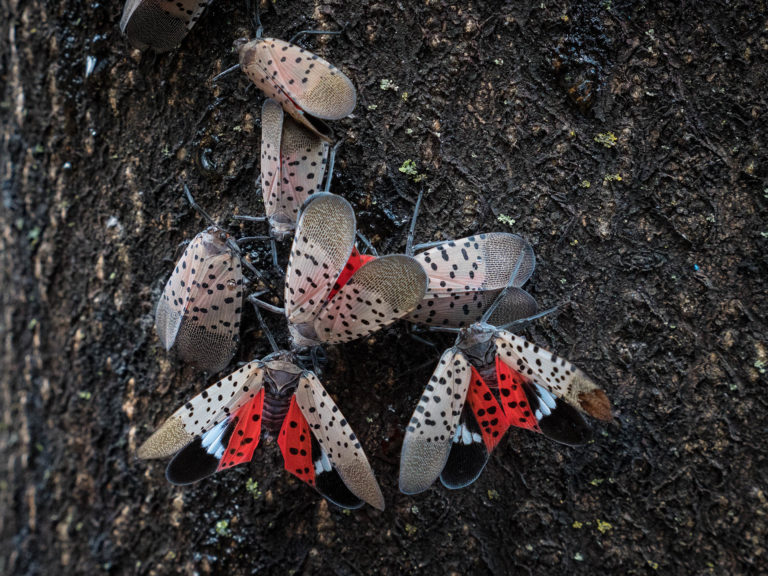
- Adults: Adult spotted lanternflies are about an inch long and have a black head. Their forewings are grayish with black spots, and their hindwings are a striking combination of red, black, and white. They are strong jumpers and will often hop away when approached. When at rest, their wings are folded, and they have a somewhat moth-like appearance. It’s the flash of red from their underwings when they jump or fly that is often the first thing people notice.
- Nymphs: The nymphs are smaller than the adults and change in appearance as they grow. In their early stages, they are black with white spots. In their final instar stage, they develop bright red patches on their bodies. The nymphs are more mobile than the adults and can be seen crawling up and down tree trunks and stems as they feed.
- Egg Masses: Spotted lanternfly egg masses are perhaps the most important thing to be able to identify, as destroying them is one of the most effective ways to control the population. The egg masses are about an inch long and look like a smear of brownish-gray mud. They can be found on a wide variety of surfaces, including tree trunks, rocks, and even outdoor furniture. The female lanternfly covers the egg mass with a waxy, protective layer that helps it to survive the winter. This covering can make the egg masses difficult to spot, as they blend in with the bark of a tree or the surface of a rock.
Operation: Get Rid of the Lanternflies
Now for the fun part: getting rid of these unwelcome guests. The New Jersey Department of Agriculture has a simple message for anyone who sees a spotted lanternfly: “Stomp it out!” That’s right, the most effective way to deal with individual lanternflies is to simply crush them underfoot. It may seem brutal, but it’s a necessary evil in the fight to protect our trees. Every lanternfly you eliminate is one less that can reproduce and contribute to the growing population.
In addition to stomping, there are several other methods you can use to control the spotted lanternfly population on your property:
- Scrape Egg Masses: From late fall to early spring, be on the lookout for egg masses. When you find one, use a plastic card or a putty knife to scrape it off into a bag or container filled with rubbing alcohol or hand sanitizer. Be sure to scrape the entire mass, as even a few remaining eggs can hatch. This is a critical step in reducing the number of lanternflies that will emerge in the spring.
- Use Traps: Circle traps are a great way to catch lanternfly nymphs as they crawl up tree trunks. You can also use sticky bands, but be sure to use them with a wildlife barrier to prevent birds and other beneficial insects from getting stuck. These traps can be a low-maintenance way to capture a large number of nymphs with minimal effort.
- Encourage Natural Predators: While there are no known predators that specifically target spotted lanternflies, some native insects and birds have been observed feeding on them. Spiders, praying mantises, and even some species of birds can help to keep the lanternfly population in check. Creating a diverse and healthy ecosystem in your yard can encourage these natural predators to stick around and lend a hand.
- Try Homemade Sprays: Some homeowners have had success using homemade sprays made from vinegar or dish soap and water. While these can be effective at killing lanternflies on contact, they should be used with caution, as they can also harm beneficial insects and plants. It’s always a good idea to test a small area first before spraying an entire plant.
Protecting Your Trees: A Proactive Approach
While getting rid of the lanternflies you see is important, it’s even more important to take proactive steps to protect your trees from infestation. One of the most effective things you can do is to remove any Tree of Heaven (Ailanthus altissima) from your property. This invasive tree is the preferred host of the spotted lanternfly, and removing it can make your property much less attractive to them. If you’re not sure if you have a Tree of Heaven on your property, a professional arborist can help you to identify it.
For high-value trees that are at risk of infestation, you may want to consider professional treatment. Systemic insecticides can be applied by a certified arborist to protect your trees from the inside out. These treatments are absorbed by the tree and then ingested by the lanternflies as they feed, providing long-lasting protection. It’s also a good idea to regularly inspect your trees for signs of spotted lanternflies, including the insects themselves, egg masses, and the telltale signs of honeydew and sooty mold. Early detection is key to preventing a small problem from becoming a full-blown infestation.
See a Lanternfly? Here’s What to Do
If you see a spotted lanternfly in Monmouth or Ocean County, the first thing you should do is kill it. After that, it’s important to report your sighting to the New Jersey Department of Agriculture. This helps the state to track the spread of the insect and to allocate resources to the areas that need them most. You can report a sighting online through the department’s website. By reporting sightings, you are playing an active role in the statewide effort to control this invasive pest.
Conclusion: We’re All in This Together
The spotted lanternfly may be a formidable foe, but it’s one that we can overcome if we all work together. By learning to identify these pests, taking steps to control them on our own properties, and reporting sightings to the state, we can help to protect our trees and our environment here in Monmouth and Ocean County from this invasive threat. So, the next time you see a spotted lanternfly, don’t just stand there – stomp it out! And if you need a little extra help in the fight, don’t hesitate to call the experts at Tree Ya Later. We are committed to helping our community combat this pest and preserve the beauty of our Monmouth and Ocean County landscapes.
Your Partner in Pest Control
Feeling overwhelmed by the spotted lanternfly invasion? Don’t let these pests get the best of you. The team at Tree Ya Later is here to help. We offer a wide range of professional tree services, including spotted lanternfly management. Our certified arborists have the knowledge and experience to assess your property, identify at-risk trees, and recommend the most effective treatment options. We use the latest techniques and products to control spotted lanternflies while minimizing the impact on the environment. Contact us today to book a free estimate and let us help you protect your trees for years to come.
Book your free estimate now: https://clienthub.getjobber.com/booking/9637a187-236f-45f9-8739-dbef414b878c/
Frequently Asked Questions (FAQ)
Q: Are spotted lanternflies harmful to humans or pets?
A: No, spotted lanternflies do not bite or sting humans or pets. They are a nuisance, but they are not dangerous. The main concern is the damage they cause to plants and trees.
Q: What is the best time of year to find and destroy spotted lanternfly egg masses?
A: The best time to find and destroy egg masses is in the late fall, winter, and early spring, before they have a chance to hatch. This is a critical step in reducing the population for the following year.
Q: Can I use pesticides to kill spotted lanternflies?
A: While some pesticides are effective against spotted lanternflies, it’s best to consult with a professional before using them. A certified arborist can help you to choose the right product and to apply it in a way that is safe for you, your family, and the environment. Improper use of pesticides can harm beneficial insects and other wildlife.
Q: What trees are most at risk from spotted lanternflies?
A: The spotted lanternfly feeds on a wide variety of trees, but its preferred host is the Tree of Heaven. Other trees that are at high risk include maples, walnuts, and fruit trees. If you have these trees on your property, it’s especially important to be vigilant about checking for signs of infestation.
Q: How can I tell the difference between a spotted lanternfly and other insects?
A: The spotted lanternfly has a very distinctive appearance, especially the adults with their spotted forewings and red hindwings. If you’re unsure, you can take a picture and compare it to images online from reliable sources like the New Jersey Department of Agriculture or Rutgers University Extension. When in doubt, it’s better to err on the side of caution and report the sighting.